Creating is an act of resistance and an antonym to fascism. Community and creation go hand in hand. At the height of fascism, survival requires persistence in how we show up for our neighbors. Sometimes that means we do our best to survive another day to keep fighting in the most simplistic yet radical ways possible. To survive, we need to eat, rest, create, and experience love and joy. Shared creativity brings communities together in a way that establishes a feeling of solidarity through shared experiences.
My parents were cooks in the military. They would serve food for hundreds to thousands of people daily. Even outside of the mess hall, the military community had to take care of each other when family members were deployed. Potlucks and meal trains were essential during times of grief, trauma, uncertainty, and violence. My parents are no longer in the military but they instilled core values in how I understand resilience and how I approach protest to systems that are harming our communities. I use my art as a weapon, not in the literal sense, but to kill hate with love.
My paintings are for everyday people to feel seen, comforted, and reflective of their complicity in oppressive systems and ideologies like fascism. When I paint, I listen to folk artists like Woody Guthrie who use art to speak on political issues. Woody once wrote in a journal entry, "I am a changer, a constant changer. I have to be or die. Because whatever stops changing is dead. And I am alive." As a painter, I am a grinder. A painting must have clarity of message to feel complete. I yearn for a death to complicity, where there is a future in which the world is better and I have nothing left to say. Till then, I must paint.
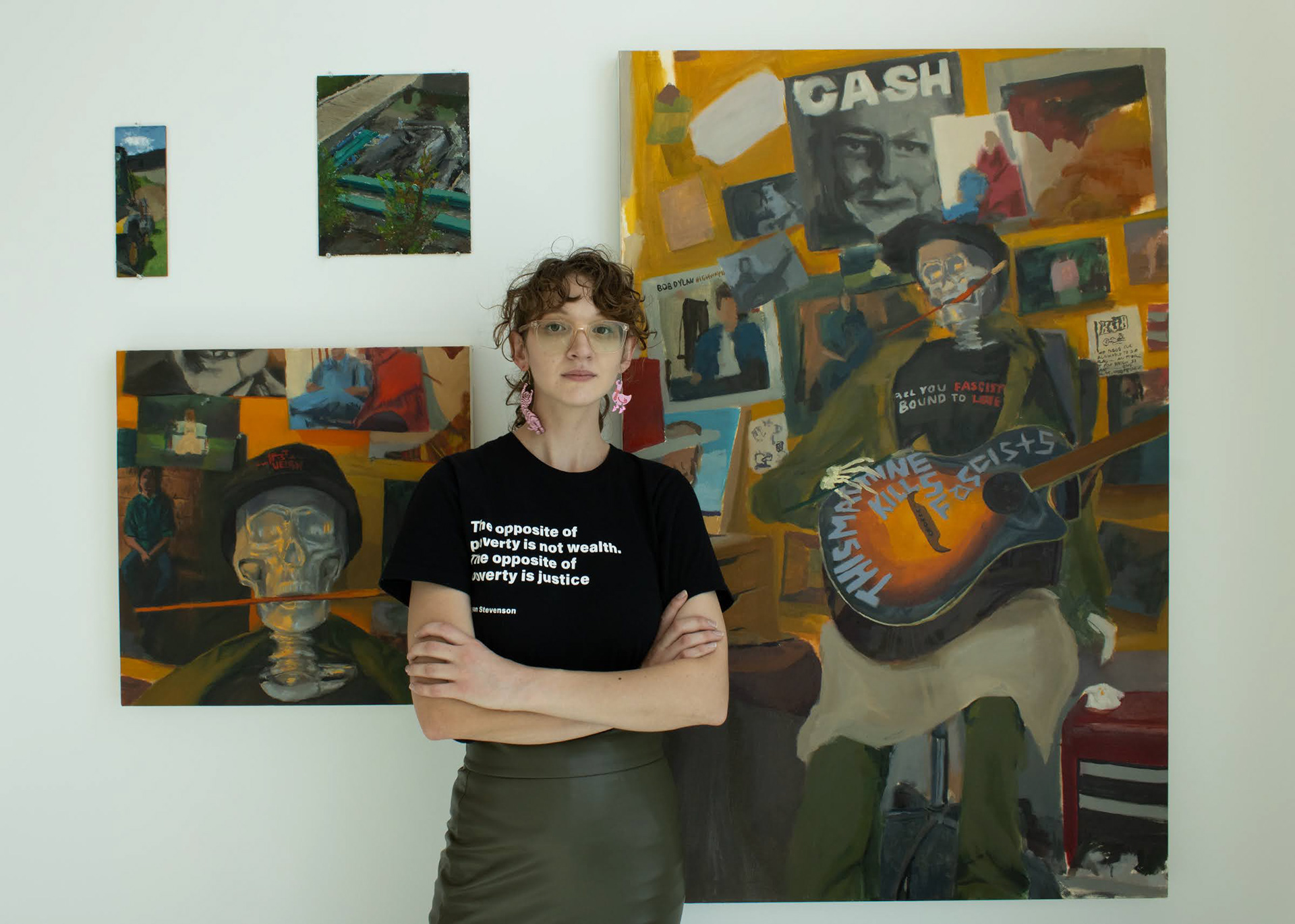
I work mostly from perception, but focus on making story driven and symbol based works that share the creative influences and visual experiences that gives me comfort and joy as a form of resistance and using a skeleton motif with political symbols to express my messages that pursue a death to my complicity in oppressive fascist systems.
In works like my painting, “This Machine Kills Fascists,” I question my tendency to fit into traditional perspective and scale by pushing the expectation of reality in hierarchy and scale through depiction of album and image references. The mark-making and color choices in my work must authentically express how I view the world around me, whether that is from direct observation or through colors I associate with my subject. I challenge myself to loosen up while also accepting an awkward tightness that reflects my personality as the marks in my paintings create a lively balance between stillness and urgency that reflect my need for change in the short and long term scheme.